ACL Reconstruction
Surgery in Lucknow
A torn ACL does not always mean the end of your active life — but it does need the right surgeon . Dr. Kamal Kishor Gupta is one of North India's most experienced ACL surgeons, performing arthroscopic ACL reconstruction at Apollomedics Super Speciality Hospital, Lucknow.
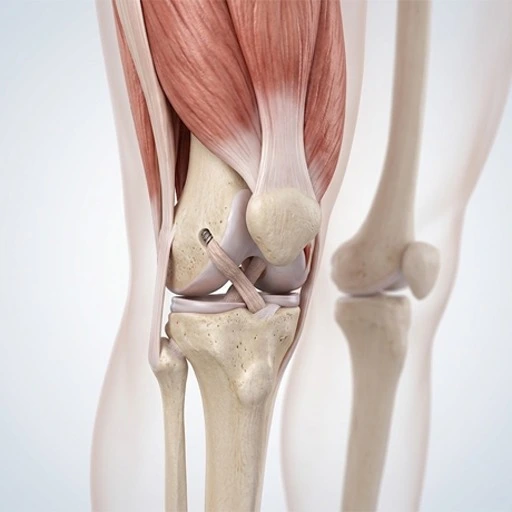
What Is the ACL and Why Does It Tear?
The ACL — Anterior Cruciate Ligament — is one of the four main ligaments inside your knee. It runs diagonally through the center of the joint and controls two things:
The ACL Controls Two Main Functions
Tibia
Forward movement of the shin bone
Femur
Thigh bone stability
Rotation
Controls twisting and pivoting stability
The ACL is most commonly torn in sports that involve sudden stops, pivoting, or landing from a jump — cricket, football, basketball, kabaddi, badminton, and skiing. It can also tear in road accidents and falls.
When the ACL tears, patients typically feel or hear a 'pop', followed by immediate swelling, pain, and a feeling that the knee 'gave way'. In many cases, you cannot continue playing or walking normally.
ACL Tear Grades
Different grades determine the severity of the ligament injury.
- ✓ Grade 1 — Ligament stretched, not torn
- ✓ Physiotherapy, rest, bracing
- ✓ Grade 2 — Partial tear — some fibres torn
- ✓ Physio or surgery depending on activity level
- ✓ Grade 3 — Complete tear — ligament fully ruptured
Symptoms of an ACL Tear — How to Know
You may have an ACL tear if you experience:
Loud 'Pop' Sound
A loud 'pop' sound or sensation at the time of injury
Severe Knee Pain
Immediate, severe knee pain
Rapid Swelling
Swelling that develops within a few hours (sometimes within 1–2 hours)
Knee Instability
Feeling that the knee is unstable or 'giving way' when walking or turning
Limited Movement
Loss of full range of motion — difficulty bending or straightening the knee
Weight Bearing Difficulty
Inability to bear weight on the affected leg
Diagnosis — How Dr. Gupta Confirms an ACL Tear
Dr. Gupta uses a combination of clinical examination and imaging to diagnose your ACL injury accurately.
Clinical Tests
Lachman Test
the most reliable physical test for ACL integrity; checks forward shift of the tibia
Anterior Drawer Test
checks forward movement of the shin bone
Pivot Shift Test
checks rotational instability of the knee
Imaging
MRI Scan
the gold standard for diagnosing ACL tears; also shows associated injuries to the meniscus, cartilage, and other ligaments
X-Ray
used to check for bone injuries and avulsion fractures associated with ligament tears
Send Your MRI on WhatsApp
If you have already had an MRI done, send the images directly. He will give you a clear diagnosis and treatment plan within 24–48 hours.
ACL Tear Treatment Options
Not every ACL tear requires surgery. Dr. Gupta assesses each patient individually based on age, activity level, injury grade, and associated damage.
Non-Surgical Treatment — Who Is It For?
- Grade 1 or Grade 2 partial tears with good stability
- Older, less active patients who do not play sports or do physically demanding work
- Patients who are willing to modify their activity level permanently
Non-surgical treatment includes:
- Structured physiotherapy to strengthen the quadriceps, hamstrings, and hip muscles
- A knee brace to provide external support during activities
- PRP (Platelet-Rich Plasma) injections — to reduce inflammation and support partial healing
- Activity modification — avoiding sports and high-demand physical activities
Surgical Treatment — ACL Reconstruction
Complete (Grade 3) ACL tears in active patients
Young patients and athletes who want to return to sport
Patients with knee instability despite physiotherapy
Associated meniscus or cartilage injuries that also need repair
Patients with a physically demanding job or lifestyle
Consult Dr. Gupta for a personalized treatment plan and get back to an active, pain-free life.
The ACL Reconstruction Surgery Procedure — Step by Step
Dr. Gupta performs ACL Reconstruction arthroscopically — using a small camera (arthroscope) and tiny instruments inserted through small cuts around the knee. There is no large open incision.
Step 1: Pre-Surgery Preparation
Before surgery, Dr. Gupta ensures the knee swelling has reduced and the quadriceps muscles are functioning. This 'pre-habilitation' — usually 2–3 weeks of physiotherapy — significantly improves post-operative recovery outcomes. Blood tests, fitness evaluation, and implant planning are also completed.
Step 2: Anaesthesia
ACL reconstruction is performed under spinal anaesthesia (you are awake but feel nothing below the waist) combined with a nerve block. This reduces post-operative pain and avoids the risks of general anaesthesia.
Step 3: Harvesting the Graft
The torn ACL cannot be stitched back together — a new ligament must be created using a graft. Dr. Gupta uses the patient's own tissue (autograft) for the best long-term results.
Step 4: Arthroscopic Tunnel Drilling
Using the arthroscope, Dr. Gupta makes precise bone tunnels in the femur (thigh bone) and tibia (shin bone) at the exact anatomical positions of the original ACL. Correct tunnel placement is the single most important factor determining long-term ACL reconstruction success.
Step 5: Graft Placement and Fixation
The graft is passed through the tunnels and positioned to replicate the original ACL. It is fixed firmly at both ends using bio-absorbable or titanium screws (or a combination), depending on the graft type. Once fixed, the knee is tested through a full range of motion to confirm stability.
Step 6: Associated Repairs
If a meniscus tear, cartilage damage, or other ligament injury is found during arthroscopy, Dr. Gupta repairs it in the same operation — so the patient recovers from all injuries at once.
Step 7: Closing and Recovery
The small incisions are closed with sutures. The knee is bandaged and a brace applied. Most patients are discharged the next day.
Graft Options Used During ACL Reconstruction
• Hamstring tendon graft (gracilis and semitendinosus) — Dr. Gupta's preferred technique; strong, reliable, minimal donor-site issues
• Patellar tendon graft (BTB — bone-tendon-bone) — used in specific high-demand athletes
• Quadriceps tendon graft — used in revision cases or when other grafts are not available
The graft choice is discussed with each patient before surgery based on their sport, lifestyle, and anatomy.
ACL Reconstruction Recovery — Timeline
Recovery after ACL reconstruction follows a structured, phase-wise protocol. Dr. Gupta's team provides a personalised rehabilitation plan for every patient.
| Phase | Timeframe | Goals / Milestones |
|---|---|---|
|
Phase 1 — Protection
|
Week 1–2 | Control swelling, gentle range of motion, walking with crutches |
|
Phase 2 — Early Rehab
|
Week 3–6 | Brace-free walking, quadriceps activation, light cycling |
|
Phase 3 — Strengthening
|
Week 6–12 | Jogging on flat surface, single-leg exercises, balance training |
|
Phase 4 — Sport-Specific
|
Month 3–5 | Running drills, agility training, sport-specific movements |
|
Phase 5 — Return to Sport
|
Month 6–9 | Full return to competitive sport after clearance testing |
Real Recovery Case
“Case: A 24-year-old cricket player from Delhi with a complete Grade 3 ACL tear and partial medial meniscus involvement. MRI reviewed remotely via WhatsApp. Arthroscopic ACL reconstruction with simultaneous meniscus repair completed in 65 minutes. Patient returned to competitive cricket at 7 months post-surgery with full range of motion. No re-injury at 18-month follow-up.”
Associated Injuries — What Else Is Often Damaged with an ACL Tear?
An ACL tear rarely happens in isolation. Dr. Gupta routinely identifies and treats associated injuries during the same arthroscopic procedure:
Medial Meniscus Tear
the most common associated injury; found in 30–40% of ACL tears
Lateral Meniscus Tear
less common but equally important to repair
Cartilage (Chondral) Damage
surface wear on the femur, tibia, or kneecap
MCL Sprain (Medial Collateral Ligament)
often injured alongside the ACL in contact sports
PCL Injury
occurs in high-energy collisions
Bone Bruising
seen on MRI; heals naturally with protected weight-bearing
Treating all injuries in one surgery reduces overall recovery time and improves long-term knee function.
ACL Reconstruction for Athletes — Return to Sport
Dr. Gupta has a special interest in sports injury management and follows evidence-based return-to-sport protocols used by international sports medicine programmes — including the FIFA Medical Diploma standards he trained under in Barcelona.
Limb Symmetry Index (LSI)
strength of the operated leg compared to the healthy leg (target: 90% or higher)
Single-Leg Hop Tests
distance and balance tests for functional strength
Sport-Specific Agility Tests
cutting, pivoting, and deceleration drills
Psychological Readiness Assessment
confidence to return to full contact sport
Return to Competitive Sport
Only when all criteria are met does Dr. Gupta clear a patient for return to competitive sport. This reduces the risk of re-injury — one of the most common problems after poorly managed ACL reconstruction.
Why Choose Dr. Kamal Kishor Gupta for Knee Replacement in Lucknow?
Dr. Kamal Kishor Gupta is among the most highly qualified knee replacement surgeons in North India, combining international training, advanced surgical expertise, and patient-focused care.
FIAA — Singapore General Hospital
Fellowship in Arthroplasty and Arthroscopy from one of Asia’s leading joint replacement centres.
MRCS — Royal College of Surgeons, Edinburgh
A globally recognised UK surgical qualification held by fewer than 1% of orthopaedic surgeons in India.
FIFA Medical Diploma — Barcelona
International certification representing the gold standard in sports medicine and joint care.
Why Patients Trust Dr. Gupta
- ✓ Explains your condition and treatment options in simple language
- ✓ Recommends surgery only when non-surgical treatments are not enough
- ✓ Offers free MRI review on WhatsApp before travelling to Lucknow
- ✓ Known for fast recovery and excellent long-term outcomes
- ✓ 580+ Google reviews with a 4.9-star average rating
If you are looking for the best Orthopedic Doctor in Lucknow, Dr. Kamal Kishor Gupta at Apollomedics is trusted by patients from across India.
Risks and Complications — What You Should Know
ACL reconstruction is a well-established, safe procedure. Dr. Gupta discusses all risks with each patient before surgery. Possible complications include:
Graft Failure or Re-Tear
risk is low with correct tunnel placement and full rehabilitation; higher if the patient returns to sport too early
Infection
rare; minimised by strict sterile protocols in Apollomedics' dedicated orthopaedic OT
Knee Stiffness (Arthrofibrosis)
prevented by starting physiotherapy from Day 1 post-surgery
DVT (Blood Clot)
prevented with blood thinners and early mobilisation
Numbness Around the Incision
usually temporary due to small sensory nerve branches
Donor Site Discomfort
mild in most patients; resolves within weeks
Low Complication Rates with International-Level Expertise
Dr. Gupta's complication rates are well below national averages — a result of his international training, precise surgical technique, and the comprehensive post-operative care at Apollomedics.
Book An Online Appointment
Our team will contact you shortly to schedule an appointment at your convenience.
Frequently Asked Questions — ACL Reconstruction in Lucknow
What happens after surgery?
Most patients are back to normal life within 3 months. Here is exactly what to expect, day by day.
Day 1 – 2
Surgery done — rest and monitor
You wake up in the ward. Pain is managed with medicines. Most patients can stand with support on Day 1 itself.
Day 3 – 7
First steps with support
You start walking with a walker. Physiotherapy begins. Most patients go home by Day 4 or 5.
Week 2 – 4
Walking improves daily
You can climb stairs slowly. Swelling reduces. You stop using the walker and switch to a stick.
Month 2 – 3
Back to normal activities
You can walk freely, cook, drive, and do light work. Most patients feel 80% better by this stage.
Month 6+
Full recovery
Complete recovery. You can live a normal, pain-free life. Many patients say they wish they had done it sooner.
Every patient recovers differently. Dr. Gupta personally monitors your recovery at every stage. You are never alone in this journey.
Book a Consultation or Send Your MRI
Apollomedics Super Speciality Hospital, Lucknow
Kanpur–Lucknow Road, Sector B, Bargawan,
LDA Colony,
Lucknow, Uttar Pradesh 226012
