Revision Knee Replacement
in Lucknow
Revision knee replacement surgery is performed to correct or replace a previous knee implant that has become worn out, loose, or painful over time. Dr. Kamal Kishor Gupta in Lucknow provides advanced revision knee surgery with a focus on improving mobility, reducing pain, and helping patients return to daily activities comfortably.
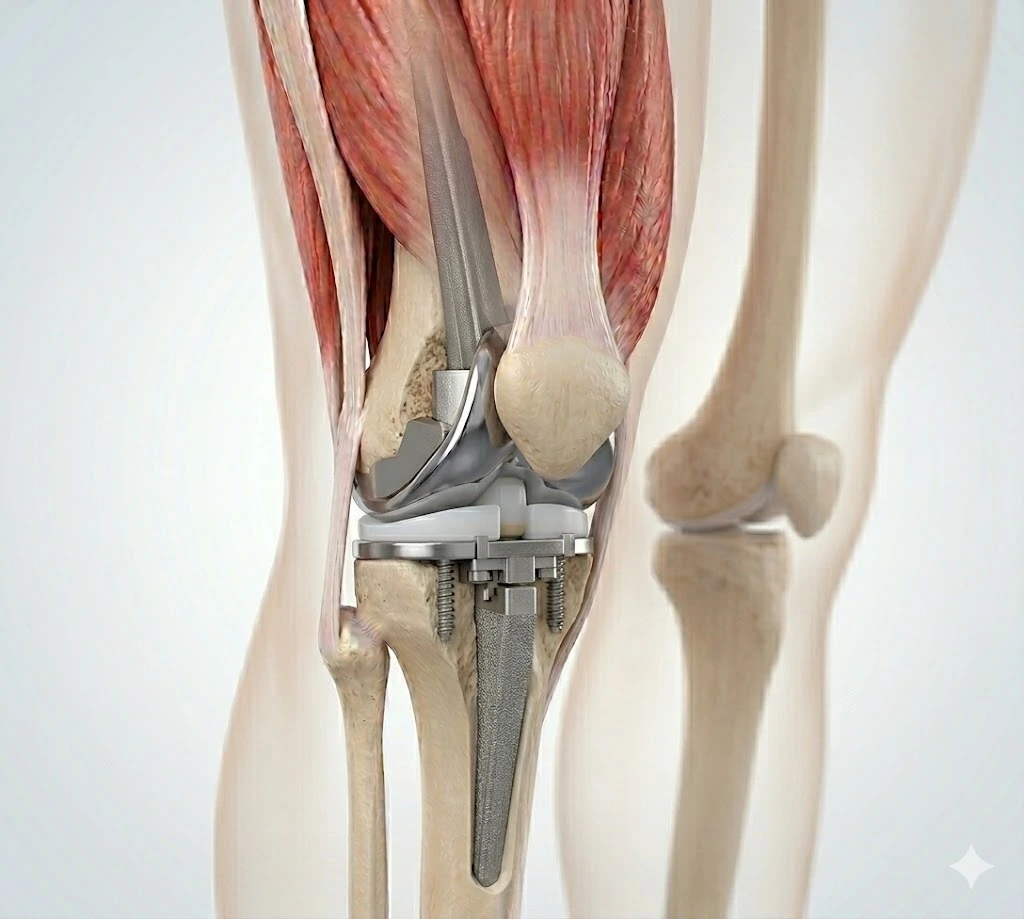
What Is Revision Knee Replacement?
A revision knee replacement is a surgery to remove and replace an old, worn, or failed knee implant with a new one. This is a complex surgery. It is not the same as your first knee replacement. It requires more planning, more surgical skill, and a more advanced implant system.
If you had a knee replacement in the past and now feel pain again, have swelling, or notice the knee is not stable — you may need revision surgery. This is more common than people think. Implants do not last forever, and problems can develop over time.
Why Do Knee Replacements Fail?
There are several reasons a knee replacement may stop working properly. Understanding the cause is the first step to choosing the right treatment.
| Common Causes of Failure | Other Reasons |
|---|---|
|
Implant loosening (most common)
|
Stiffness or limited movement |
|
Wear of the plastic (polyethylene) liner
|
Fracture around the implant (periprosthetic fracture) |
|
Joint infection (periprosthetic infection)
|
Implant malalignment from original surgery |
|
Instability — knee feels wobbly
|
Knee cap (patella) problems |
Dr. Gupta uses detailed X-rays, CT scans, blood tests, and sometimes joint fluid testing to find the exact cause before recommending treatment.
Signs You May Need Revision Knee Surgery
Do not ignore these warning signs after a previous knee replacement:
Knee pain that returned after a period of being pain-free
Swelling that does not go away with rest or medicines
Knee feels loose or gives way when you walk
You can feel or hear a click or clunk inside the knee
Fever, redness, or warmth around the knee (may be infection)
Difficulty walking stairs or getting up from a chair
X-ray shows the implant has shifted or bone has thinned around it
If you have any of these symptoms, send your X-ray or MRI to Dr. Gupta on WhatsApp for a free review. You will get a clear, honest answer within 24 to 48 hours.
How Dr. Kamal Kishor Gupta Approaches Revision Knee Surgery
Revision surgery is not a simple repeat of the first operation. Every case is different. Dr. Gupta follows a step-by-step process to make sure you get the right treatment — and not just another operation.
01 — Step 1 — Detailed Evaluation
Full review of your old surgery reports, implant details, current X-rays, and if needed, CT scan or MRI. Blood tests to rule out infection before any surgical planning.
02 — Step 2 — Finding the Root Cause
Dr. Gupta identifies exactly why the original replacement failed — loosening, infection, wear, or alignment. The revision plan is based on the cause, not a standard protocol.
03 — Step 3 — Pre-Surgery Planning
Templating the correct implant size and type. Revision implants are longer and more constrained than primary implants. Bone graft planning if bone loss is present.
04 — Step 4 — The Operation
The old implant and cement are carefully removed. Bone is prepared. New revision implant is fitted with stems that go deeper into the bone for stronger fixation. Takes 2 to 3 hours.
05 — Step 5 — Recovery and Rehabilitation
Walking with support starts on Day 1 or 2 after surgery. Structured physiotherapy for 3 to 6 months. Full recovery typically takes 6 to 12 months depending on the extent of revision.
Types of Revision Knee Replacement Surgeries
1. Liner Exchange (Partial Revision)
Only the plastic insert between the metal parts is replaced. The metal femoral and tibial components are kept if they are still well-fixed. This is the least complex form of revision surgery and has a faster recovery.
2. Single Component Revision
Only one part — the femoral (thigh bone side) or tibial (shin bone side) component — is replaced. This is done when only one part has failed while the other remains stable.
3. Full Revision Knee Replacement
Both metal components and the plastic liner are completely removed and replaced. This is needed for severe loosening, implant failure, or infection. Dr. Gupta uses modern revision implant systems with stems and augments to restore knee function even when significant bone has been lost.
4. Revision for Infection (Two-Stage Revision)
If the knee replacement has become infected, a two-stage process is used. In Stage 1, the implant is removed and an antibiotic spacer is placed inside the knee. After 6 to 8 weeks of antibiotic treatment and confirmed clearance of infection, Stage 2 is done — a new revision implant is placed. This approach gives the best chance of eliminating infection completely.
Revision Implants — What Makes Them Different
Revision implants are designed for situations where standard implants cannot work. They are larger, more constrained, and have long stems that pass down into the bone canal for better stability.
| Revision Implant Features | Clinical Benefits |
|---|---|
|
Longer intramedullary stems for fixation
|
Better bone-implant contact |
|
Augments to fill bone defects
|
Handles more bone loss than primary implants |
|
Higher constraint for unstable knees
|
Can be customised for each patient |
|
Modular design — built intraoperatively
|
Used with or without bone graft |
At Apollomedics Super Speciality Hospital in Lucknow, Dr. Gupta has access to advanced revision implant systems used in the best hospitals across India and internationally.
Revision Knee Replacement for Infection — A Special Case
Periprosthetic joint infection (PJI) — infection around a knee implant — is one of the most serious complications after knee replacement. It is also one of the hardest to treat. Dr. Gupta has specific experience in managing infected knee replacements using the gold-standard two-stage revision approach.
How to Spot Infection
Persistent pain, warmth, redness, or discharge around the knee — especially months after surgery — may be signs of infection. Get blood tests (CRP, ESR, WBC) and a joint fluid sample done before assuming it is a mechanical problem.
Recovery After Revision Knee Surgery
Recovery after revision surgery is longer and more involved than after a first knee replacement. Here is a realistic guide to what to expect:
| Timeline | What You Can Expect |
|---|---|
|
Day 1–2
|
Walk with support (walker or frame). Physiotherapy begins. |
|
Week 1–2
|
Discharge from hospital. Home exercises begin. Swelling reduces. |
|
Week 4–6
|
Walking without support for short distances. Stairs with railing. |
|
Month 3
|
Most daily activities resume. Driving may be allowed. |
|
Month 6–12
|
Full recovery. Return to normal life including moderate activity. |
Important Recovery Note
Complex revisions — especially two-stage infection treatment — may have a longer timeline. Dr. Gupta explains your personal recovery plan clearly before surgery.
Are You a Candidate for Revision Knee Surgery?
You may be a candidate for revision knee replacement if:
Your previous knee replacement was done more than 10 to 15 years ago and the implant is worn out
X-rays show the implant has loosened from the bone
You have a confirmed or suspected joint infection
- ✓ Your knee is unstable and conservative treatment has not helped
- ✓ You had a fracture near the old implant
- ✓ Your knee was painful from the start and never fully recovered
Not everyone needs revision surgery. Dr. Gupta carefully evaluates whether your symptoms can be managed without an operation. Many patients referred for revision surgery are successfully treated with physiotherapy, injections, or medicines. Surgery is only recommended when it is clearly the right answer.
Why Choose Dr. Kamal Kishor Gupta for Revision Knee Surgery in Lucknow?
Revision knee surgery is among the most technically demanding procedures in orthopaedics. Experience and training matter enormously. Here is why patients from across India — Delhi, Kanpur, Varanasi, Gorakhpur, and beyond — choose Dr. Gupta for this complex surgery:
| International Qualifications | Clinical Experience |
|---|---|
| FIAA — Fellowship in Arthroplasty & Arthroscopy, Singapore General Hospital | Performed revision surgeries including complex two-stage infection cases |
| MRCS — Royal College of Surgeons, Edinburgh (held by fewer than 1% of orthopaedic surgeons in India) | Access to advanced revision implant systems at Apollomedics |
| FIFA Medical Diploma — Barcelona (sports medicine gold standard) | Robotic surgery suite for precision implant positioning |
| 12+ years of surgical experience in knee replacement and revision | 580+ Google reviews, 4.9 star average — verified patient outcomes |
International Orthopaedic Training
Dr. Gupta trained at three of the world's leading orthopaedic institutions. This level of international training is virtually unmatched among best Orthopedic Doctor in Lucknow.
Free MRI / X-Ray Review on WhatsApp
Not ready to travel yet? Not sure if your knee replacement has actually failed? Dr. Gupta personally reviews X-rays and MRI scans sent on WhatsApp — free of charge, with no registration required.
01 — Send Your Scans
Take photos of your X-ray or MRI report, or save as PDF. Send directly to Dr. Gupta on WhatsApp at +91 85889 53161.
02 — Get a Personal Review
Dr. Gupta reviews your case personally and responds within 24 to 48 hours in simple language — not medical jargon.
03 — Decide With Confidence
You will know exactly whether revision surgery is needed, what type, what to expect, and what it will cost. Then book your visit to Lucknow when you are ready.
Quick, Honest, and Personal Review
Thousands of patients from Delhi, Kanpur, Varanasi, and across North India use this service every year. It costs nothing and takes less than 2 minutes to send.
Book An Online Appointment
Our team will contact you shortly to schedule an appointment at your convenience.
Common Questions About Revision Knee Replacement
What happens after surgery?
Most patients are back to normal life within 3 months. Here is exactly what to expect, day by day.
Day 1 – 2
Surgery done — rest and monitor
You wake up in the ward. Pain is managed with medicines. Most patients can stand with support on Day 1 itself.
Day 3 – 7
First steps with support
You start walking with a walker. Physiotherapy begins. Most patients go home by Day 4 or 5.
Week 2 – 4
Walking improves daily
You can climb stairs slowly. Swelling reduces. You stop using the walker and switch to a stick.
Month 2 – 3
Back to normal activities
You can walk freely, cook, drive, and do light work. Most patients feel 80% better by this stage.
Month 6+
Full recovery
Complete recovery. You can live a normal, pain-free life. Many patients say they wish they had done it sooner.
Every patient recovers differently. Dr. Gupta personally monitors your recovery at every stage. You are never alone in this journey.
Book a Consultation or Send Your MRI
Apollomedics Super Speciality Hospital, Lucknow
Kanpur–Lucknow Road, Sector B, Bargawan,
LDA Colony,
Lucknow, Uttar Pradesh 226012
