High Tibial Osteotomy
Surgery in Lucknow
If you have knee pain from early arthritis — but you are too young for a knee replacement — High Tibial Osteotomy (HTO) may be the right surgery for you. Patients come from Delhi, Kanpur, Varanasi, Agra, Gorakhpur, and across North India for this treatment.
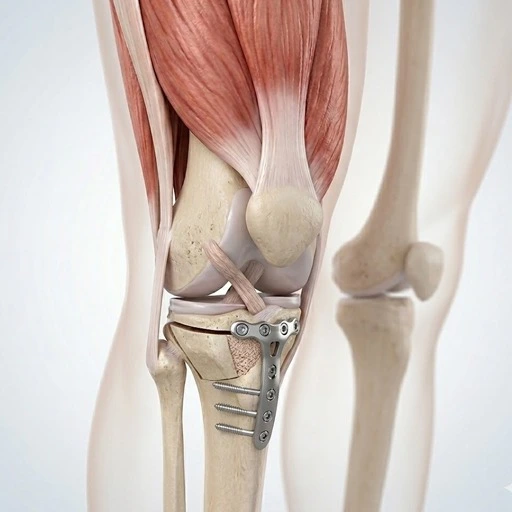
What Is High Tibial Osteotomy (HTO)?
High Tibial Osteotomy — or HTO — is a surgery where the tibia (shin bone) is carefully cut and realigned to change the angle of the knee joint.
In a healthy knee, body weight is shared equally across the inner (medial) and outer (lateral) sides of the joint. When the knee is bowed inward (varus deformity / bow legs), almost all the weight falls on the inner side — wearing it out far faster than normal. This is what causes pain, stiffness, and early arthritis in one part of the knee.
In an HTO, Dr. Gupta corrects this alignment. By slightly opening or closing a wedge in the upper tibia, he shifts the weight-bearing axis away from the damaged inner side and onto the healthier outer side. The damaged cartilage is no longer under constant pressure — so it can recover, and the arthritis stops progressing as fast. Think of it like correcting the wheel alignment on a car. If one tyre is always taking the full load, it wears out quickly. Align the wheels correctly, and all four tyres last much longer. HTO does the same for your knee.
Who Needs High Tibial Osteotomy Surgery?
HTO is not for everyone. It is specifically designed for patients who meet a certain profile. You may be a good candidate if you:
Age and Arthritis
Are between 30 and 60 years of age with early-to-moderate arthritis
Bow Legs (Varus Deformity)
Have bow legs (varus deformity) — where your knees angle outward when standing
Inner Knee Arthritis
Have arthritis only on the inner (medial) side of the knee — not the full joint
Active Lifestyle
Are physically active and want to return to work, sports, or an active lifestyle
Persistent Knee Pain
Have knee pain that is not relieved by medicines, physiotherapy, or injections after 3–6 months
Not Ready for Total Knee Replacement
Are not yet ready — or not suitable — for a Total Knee Replacement
Stable Knee
Have a stable knee with intact ligaments
Important Note
HTO is not usually suitable if you have full-joint (tricompartmental) arthritis, severe bone loss, significant knee instability, or are significantly overweight.
High Tibial Osteotomy vs. Total Knee Replacement — What Is the Difference?
Many patients ask: why not just do a knee replacement? The answer depends on your age and activity level.
| Comparison | High Tibial Osteotomy (HTO) | Total Knee Replacement (TKR) |
|---|---|---|
|
Best Age Group
|
30–60 years | 60+ years |
|
Arthritis Type
|
One side of the knee (medial) | Full knee joint |
|
Preserves Natural Knee?
|
Yes — your own knee is kept | No — joint is replaced with implant |
|
Return to Sports?
|
Yes — high-impact activity possible | Low-to-moderate activity only |
|
Implant Required?
|
No implant — bone is realigned | Metal and plastic implant inserted |
|
How Long Does It Last?
|
10–15+ years before any replacement needed | 15–20 years |
Why HTO Is Often Better for Younger Patients
For younger patients who are active and have one-sided knee arthritis, HTO is often the better choice — it preserves your natural joint, allows return to full activity, and can delay knee replacement by 10 to 15 years or more.
Types of High Tibial Osteotomy Dr. Gupta Performs
Dr. Gupta performs different HTO techniques depending on the deformity pattern, alignment correction required, and patient activity level.
1. Opening Wedge HTO
- Dr. Gupta makes one precise cut on the inner side of the tibia and gently opens it like a book
- A small bone graft or wedge-shaped implant is placed in the gap to hold the new angle
- This is the most widely used technique today — it is precise, adjustable, and gives excellent long-term results
Advantages of Opening Wedge HTO:
- Single incision, no need to cut the fibula
- More accurate correction of the alignment angle
- Fixed with a titanium plate and screws for strong, stable healing
2. Closing Wedge HTO
A small wedge of bone is removed from the outer side of the tibia
The two bone surfaces are brought together and fixed with plates
This technique is sometimes preferred for specific deformity patterns
Good for certain varus patterns where more correction is needed on the outer side
Well-established technique with a long surgical history
The High Tibial Osteotomy Procedure — Step by Step
Here is what happens during the HTO procedure performed by Dr. Gupta.
Step 1: Pre-Surgery Planning
Before the operation, Dr. Gupta does a detailed review of your weight-bearing X-rays, MRI, and lower limb alignment measurements. He uses precise calculations — called the mechanical axis — to plan exactly how much correction is needed to shift the load off your damaged knee. This planning step is critical. The angle of correction must be precise — even a small error changes the outcome.
Step 2: Anaesthesia
Most patients receive spinal anaesthesia — you are awake but feel nothing below the waist. This is safer than general anaesthesia and speeds up recovery. A nerve block is also given so you feel minimal pain after the procedure.
Step 3: The Bone Cut (Osteotomy)
Dr. Gupta makes a careful incision on the inner side of the upper tibia. Using precision surgical instruments, he makes a controlled cut in the bone — stopping just short of the outer cortex, which acts like a hinge. The bone is then gently opened to the exact angle planned before surgery.
Step 4: Holding the New Position
A titanium plate and screws are used to fix the bone in its new, corrected position. In opening wedge HTO, the gap is filled with a bone graft (either from the patient or a donor) to help the bone heal solidly in the new alignment.
Step 5: Closing and Recovery
The incision is closed carefully. Dr. Gupta uses a multimodal pain protocol — a combination of nerve blocks and local anaesthetic injections — so most patients feel very little pain after surgery and do not need strong painkillers.
Recovery After High Tibial Osteotomy — What to Expect
HTO is a bone-healing procedure. The tibia needs time to grow and consolidate in its new position. Here is a general recovery guide:
Hospital Stay
Most patients stay in hospital for 1–2 days. Pain is well managed. You will begin gentle movement and physiotherapy from the first day itself.
Home Rest with Crutches
You go home with crutches and a clear set of exercises. No weight is put on the operated leg for the first 4–6 weeks while the bone heals.
Start Walking
Once X-rays confirm the bone is healing well, Dr. Gupta allows gradual weight-bearing. Most patients begin walking without crutches around 6–8 weeks.
Independent, Pain-Free Walking
The large majority of patients are walking comfortably and independently by 3–4 months. Light daily activities are fully restored.
Return to Activity
Cycling, swimming, and outdoor walking are resumed. Physiotherapy continues to rebuild strength and stability in the knee.
Full Recovery Including Sports
Most active patients are cleared for full return to sports, running, and physically demanding work by 9–12 months after surgery.
A 42-year-old construction worker from Kanpur with severe bow legs and Grade II medial arthritis underwent Opening Wedge HTO under Dr. Gupta. He returned to work at 4 months — with straight legs, no knee pain, and no need for a knee replacement.
Non-Surgical Options — Dr. Gupta Tries Everything First
Before recommending HTO surgery, Dr. Gupta considers all non-surgical treatments:
PRP Therapy (Platelet-Rich Plasma)
injections to reduce inflammation and support cartilage
GFC Therapy (Growth Factor Concentrate)
advanced regenerative injection for early joint damage
Physiotherapy Programme
structured muscle strengthening to reduce load on the medial compartment
Unloader Knee Bracing
a special brace that shifts load away from the damaged side of the knee
Hyaluronic Acid Injections
joint lubrication for mild arthritis and stiffness
Weight Management and Activity Modification
to reduce overall joint load
When Surgery Is Recommended
Surgery is recommended only when these options have been tried and have not given enough relief — or when the malalignment is severe enough that non-surgical treatment alone cannot help.
Why Choose Dr. Kamal Kishor Gupta for High Tibial Osteotomy in Lucknow?
Dr. Kamal Kishor Gupta is one of the most qualified orthopaedic and joint-preservation surgeons in North India. His international training sets him apart from most orthopaedic surgeons in Uttar Pradesh:
FIAA — Singapore General Hospital
Fellowship in Arthroplasty and Arthroscopy from one of Asia's top joint surgery centres
MRCS — Royal College of Surgeons, Edinburgh
a globally recognised UK surgical qualification held by fewer than 1% of orthopaedic surgeons in India
FIFA Medical Diploma — Barcelona
the gold standard in sports medicine and joint care
Why Patients Choose Dr. Gupta
- ✓ He is a specialist in joint-preservation surgery — saving knees, not just replacing them
- ✓ He explains your condition and all options in plain language — not medical jargon
- ✓ He does not rush to surgery if non-surgical treatment can help
- ✓ He is available for a free MRI review on WhatsApp — even before you travel to Lucknow
- ✓ His patients consistently report fast recovery and excellent long-term outcomes
- ✓ 580+ Google reviews with a 4.9-star average
If you are looking for the best Orthopedic Doctor in Lucknow, Dr. Kamal Kishor Gupta at Apollomedics is a name trusted by patients across India.
Risks and Complications — What You Should Know
High Tibial Osteotomy is a well-established and safe procedure. However, like any surgery, it carries some risks. Dr. Gupta discusses these with every patient before the operation.
Infection
rare, minimised by strict OT protocols at Apollomedics
Delayed Bone Healing or Non-Union
the bone takes longer to heal in a small number of cases
Hardware Irritation
the titanium plate and screws may occasionally cause discomfort and can be removed after full healing
Undercorrection or Overcorrection
if the alignment angle is not quite right, a revision may be needed (extremely rare with careful pre-op planning)
Blood Clot (DVT)
prevented with blood thinners and early mobilisation
Stiffness
prevented by starting physiotherapy from day one
Low Complication Rates with International-Level Expertise
Dr. Gupta's complication rate is well below national averages — a result of his international training, meticulous pre-surgical planning, and the advanced facilities at Apollomedics Super Speciality Hospital, Lucknow.
Book An Online Appointment
Our team will contact you shortly to schedule an appointment at your convenience.
Frequently Asked Questions
What happens after surgery?
Most patients are back to normal life within 3 months. Here is exactly what to expect, day by day.
Day 1 – 2
Surgery done — rest and monitor
You wake up in the ward. Pain is managed with medicines. Most patients can stand with support on Day 1 itself.
Day 3 – 7
First steps with support
You start walking with a walker. Physiotherapy begins. Most patients go home by Day 4 or 5.
Week 2 – 4
Walking improves daily
You can climb stairs slowly. Swelling reduces. You stop using the walker and switch to a stick.
Month 2 – 3
Back to normal activities
You can walk freely, cook, drive, and do light work. Most patients feel 80% better by this stage.
Month 6+
Full recovery
Complete recovery. You can live a normal, pain-free life. Many patients say they wish they had done it sooner.
Every patient recovers differently. Dr. Gupta personally monitors your recovery at every stage. You are never alone in this journey.
Book a Consultation or Send Your MRI
Apollomedics Super Speciality Hospital, Lucknow
Kanpur–Lucknow Road, Sector B, Bargawan,
LDA Colony,
Lucknow, Uttar Pradesh 226012
